
 NEWS
NEWSDifferences Between Replicas: A Review of 'Repetition of Control'

VIEW OF REPETITION OF CONTROL (ROC), 2026.
June 5 2026, Published 1:20 a.m. ET


The month of May was occupied by repeated gallery visits, opening nights, exhibition walkthroughs, and whatever events the rest of the art world may be. This is no surprise to anyone in the industry, as it is art week in New York, and everyone was chasing one thing after another, crossing off their itineraries, simply trying to survive through this madness. During such, stumbling upon a show that utilizes the act of repetition as resistance and refusal was the exact reminder that I did not know I needed. Opened on May 15 as a part of New York Design Week, also known as the NYCxDesign festival, Repetition of Control (ROC) was presented in Brooklyn, New York, as a part of Art + Design. Each exploring their own relation with repetition and the oftentimes invisible labor involved behind such, the exhibition gathers artists working across illustration, design, installation, and new media. Looking closely at repetition as processes, rituals, patterns, cycles, and memories, ROC offered a fresh point of view that invites questions and conversations on how repetition can be observed and experienced throughout our daily lives. Through showcasing works that incorporate recurring materials, repeated artistic processes, and replicated objects, the show conveys the diverse connotations of the word repetition that go beyond the simple act of carrying out an action again and again.
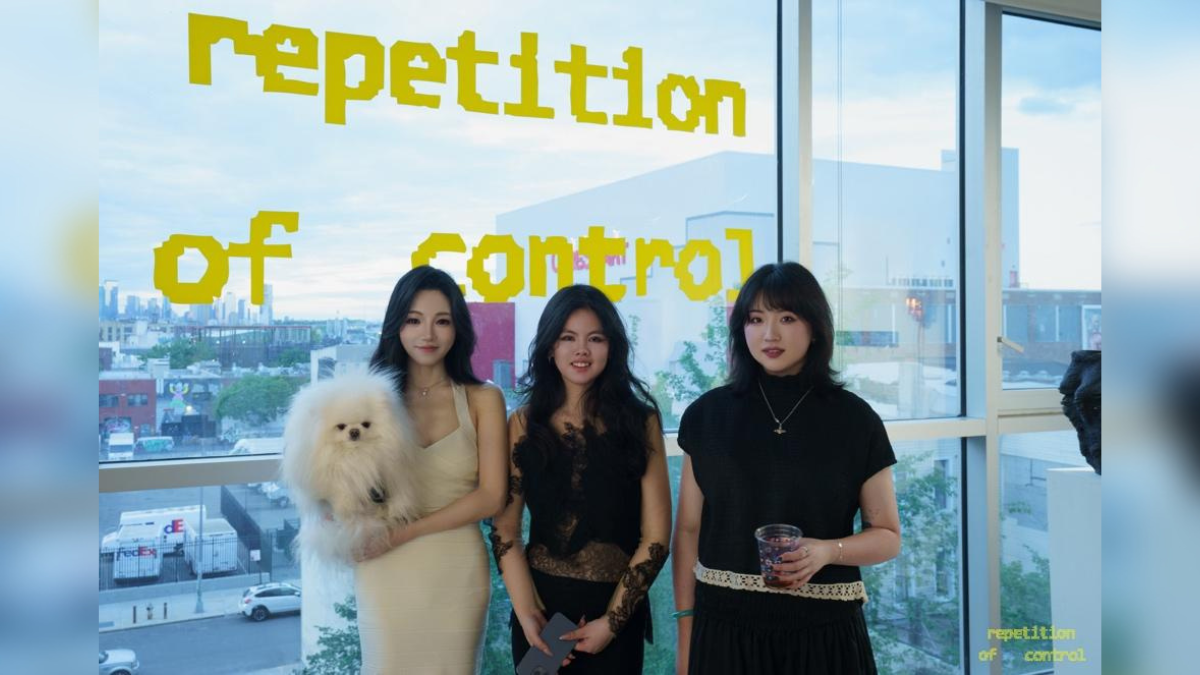
CHENYANG NIE, SOPHIE WEI AND KEJIA YAN.

ROC was a dynamic showcase of “repetition, systems, memory, labor, and contemporary forms of control” as described by the co-curating organization Artistry Edge, which developed this joint effort with creative studio Soft Hours Studio and designer Sophie Wei to realize this exhibition. Initiated and produced by Artistry Edge, a Los Angeles-based nonprofit curatorial platform founded by Chenyang Nie dedicated to supporting emerging artists and designers, ROC began as a curatorial project to further its mission of investing in the next generation of creative voices and supporting the cultivation of future talents who will shape the contemporary art landscape. The team oversaw the entire curatorial and production process of ROC, from securing its participation in the NYCxDesign Festival to curatorial research and artist sourcing. Working closely with artists and collaborators, the team also spearheaded exhibition planning and production logistics, including exhibition design, promotional strategies, media outreach, and on-site installation coordination, facilitating the translation of curatorial concepts into a cohesive public-facing exhibition experience.
Co-curating this experience, Soft Hours Studio is led by co-founder Kejia Yan, who aims to explore textiles as both material and language through machine knitting, material experimentation, and interdisciplinary practices. Bridging craft, design, and contemporary art, the studio develops exhibitions, workshops, artist collaborations, and educational programming that expand the role of textiles beyond traditional craft contexts into contemporary cultural discourse and public engagement. Rooted in an interest in repetitive structures, tactile processes, and systems of making, bringing Soft Hours Studio on board as the co-curator of this project helped further explore how the repetitive textile practices can function simultaneously as methods of production, carriers of memory, and mediums for artistic expression. As co-organizer and co-curator, Yan expressed her hopes to create stronger platforms and support systems for emerging artists while fostering a more connected and experimental contemporary art and design community in New York.
Sharing this vision of supporting the next generation of artists and designers, Sophie Wei led the creative direction of the exhibition’s visual identity, graphic assets, and conceptual framework, connecting artists and designers across physical exhibitions and digital discourse. Wei is a brand experience designer and creative director and has been a long-time collaborator of Artistry Edge in expanding exhibition and communication platforms across different cities and creative communities. Through exhibition graphics, curatorial language, spatial storytelling, and public discussion, Wei’s work attempts to create environments where philosophy, design, branding, and community engagement coexist as part of the same cultural conversation. While ROC explores themes of repetition, systems of control, authorship, and creative autonomy, Wei explained that this concept strongly resonates within New York’s contemporary design landscape, where conversations around labor, visibility, algorithms, and aesthetics increasingly intersect.
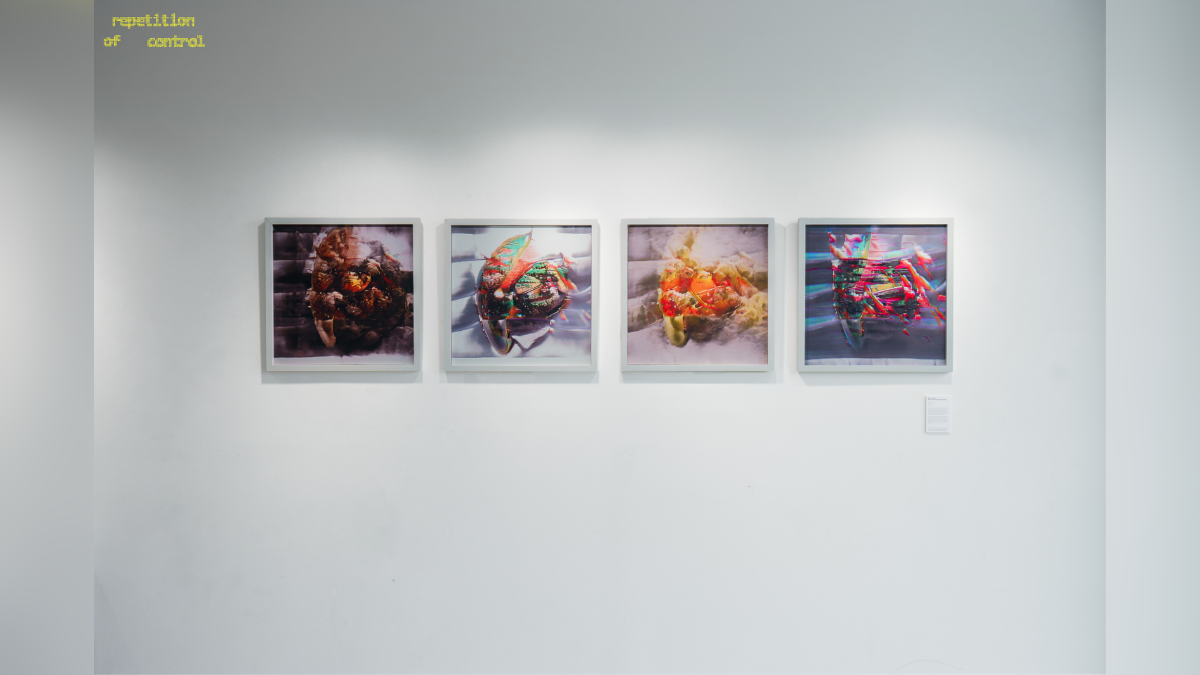
SEED GALLERY (GAURAV DUA & JONATHAN PENVOSE), FROM LEFT TO RIGHT: SEED 001, SEED 002, SEED 003, SEED 004, 2023.
On the relation of repetition and algorithms, a series of prints named The Seeds (2023) by Seed Gallery in the show exemplifies this very concept and asks: what happens to living form when it passes through a digital system? The series consists of four works created through printing organic structure directly onto squared acrylic sheets by layering individual colors one at a time, which resulted in works that build up in texture and act as an embodiment of the creative process itself. The four works seem to represent the same organic structure, repeating and replicating one another through the designed algorithm, though each in a distinct color combination and with accidental glitches. The artist duo, Gaurav Dua and Jonathan Penvose, stated that, “We see repetition as a place of tension rather than just a mechanism of control. Patterns imposed on living matter tend to fracture. They glitch. They resist. The glitch, for us, is not a failure. It is the point.” For them, repetition is resistance. It is the way to fight against algorithms, where no matter how hard one tries to replicate, organic materials and processes will refuse replication through their very nature.
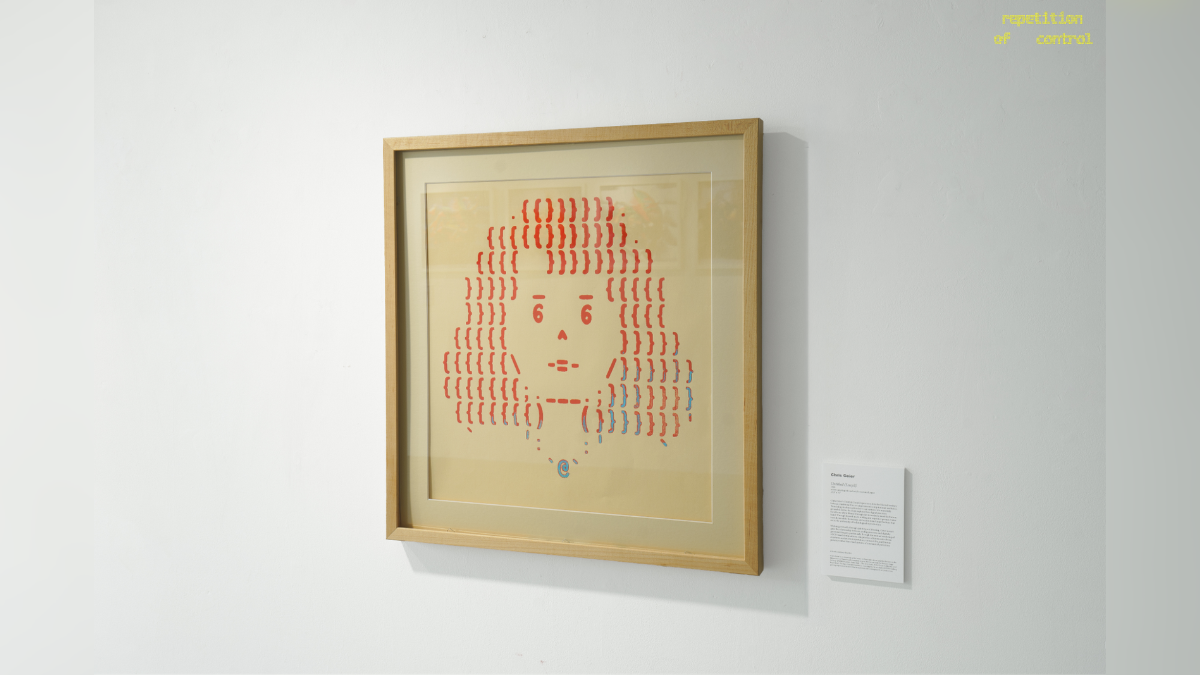
CHRIS GEIER, UNTITLED (LUCY2), 2026.
On the walls right across The Seeds (2023), a print by Chris Geier also seems to explore a similar theme of human interventions in repetitive machinery processes. Geier’s work, Untitled (Lucy2) (2026), shows the portrait of a female-looking figure that is constructed by a series of orange red punctuation marks, parentheses, curly brackets, semicolons, and more. On the bottom right corner of the figure though, is a mixture of red and blue marks that hints his approach to “resist the uniformity of technological reproduction.” The punctuation marks also varies in thickness, as if some were printed in bold and others were not. These are described by Geier as a result of the layered mark-making method he implemented to create this work, where inconsistencies and imperfections suggest resistance towards the machine-generated patterns and the repetitive process of print-making.
Sharing a similar title with the works by Seed Gallery, artist and illustrator Weiyi Li presented one of her works made through etching. This piece, titled Seed (2026), carries the message of Seed Gallery that repetition for the organic means resistance but twists it gently into a less rebellious one, one that celebrates the beauty and persistence of nature, survival, and renewal. At the center of this monotone etching print is a figure with flowers blooming from its chest that has a subtle reddish pink hue to it. Li explains that to her, repetition exists within both bodily memory and natural cycles: every division of a cell, every unfolding petal, every emergence from the cocoon becomes an act of return and persistence. The work ultimately positions rebirth not as a singular event, but as an ongoing promise between body and soul—a quiet insistence on continuing to bloom despite being worn down, peeled open, again and again.
Want OK! each day? Sign up here!
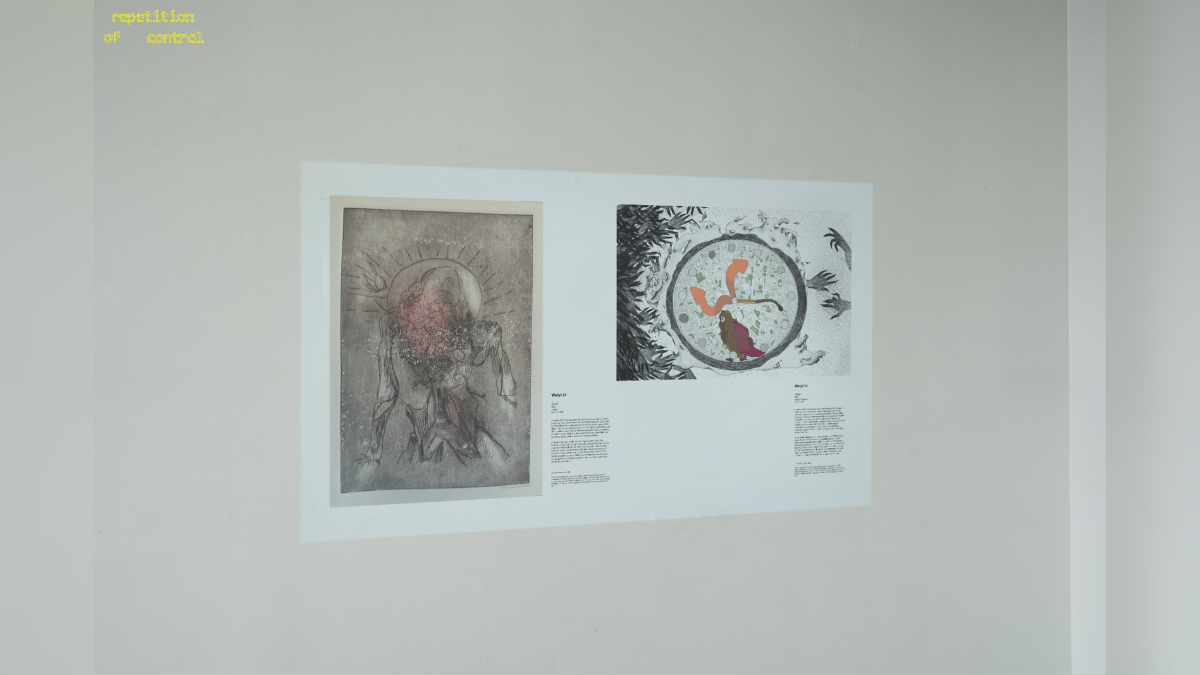
WEIYI LI, LEFT: SEED, 2026. RIGHT: GEAR, 2026.
Li’s works are often soft and narrative-driven, exploring themes such as growth, loneliness, memory, and the subtle emotional connections between individuals and the world around them. On view also in ROC, Li’s digital illustration piece, Gear (2026), approaches repetition through illustrating the story of a girl in a surreal psychological landscape, walking inside of what looks like a clock with hands that are almost forcing her to continue moving forward in this endless loop. The work questions our relationship with routines, where the artist describes that to repeat is to obey a silent contract in which movement continues endlessly without a resolution. The clock acts as a physical representation of an unsigned contract between the figure and this mechanism: she walks, it turns; it turns, she walks. As if the figure inside the clock symbolizes every single one of us, following the unspoken rules and norms of society, being forced to chase dreams, success, or happiness without a chance to question the system itself. Together, the two works of Li explore the duality of repetition, split between the difference of agency. It can at times be celebrated because of its continuity, persistence, and self-renewing nature, but at the same time, repetition can also represent the act of simply obeying and one’s lack of agency.
Li was not the only artist to celebrate the quiet persistence of repetition. The work by Songer Yang expands this persistence to express love, grief, and, as a process of healing. On view in ROC, Yang presented a collection of handmade spoons that are close to identical, laid in rows, one next to the other. This installation is perhaps the work that most recognizably embodies the idea of repetition in the physical sense, but the story behind it surpasses what the viewer can see with their eyes. Spoon (2024-2025) is a project created by Yang as an effort to retrieve and reconnect with her family history, memories, and rituals. The artist recalls a spoon that she had lost about 10 years ago, the one she always reached for to eat steamed eggs made by her grandmother. To Yang, the spoon represented her intimate bond with her family and memories that only existed around the dining table, which she then stated that losing it felt like having a piece of her history cut out. As an act of healing and grief, the artist turned to repetitive hand labor, using the techniques her grandfather taught her, and hammered copper scraps from an old rice cooker and other broken appliances she had at home to make spoons. One spoon a day, working only from memory, Yang made Spoon (2024-2025) through repetition that carried the weight of love, as if the more she repeated this process, the more love there was to be expressed. However, she then realized that repetition also erases—the more spoons she made, the more the memory began to fade and blur. To the point where she could no longer recall what the original looked like and started to question: were these still my spoon? This yet again comments on the duality of repetition. While repeating processes, it means love, memory, and nostalgia, it is also a process of erasure and erosion, rather than preservation, for that the copy will slowly replace the original until the original is gone entirely.
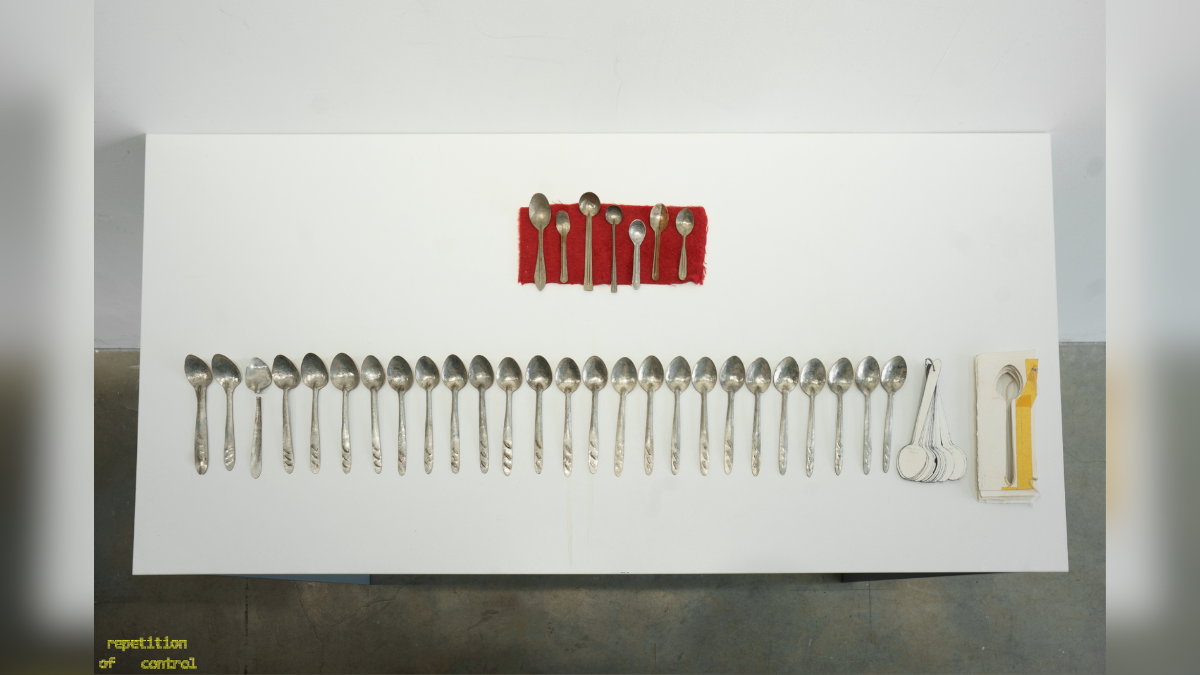
SONGER YANG, SPOON, 2024-2025.
Besides the repetitive making of spoons, a pottery work in the show also tells the story of remembering through handmade creations. Through hand-coiling pottery, Alice Tedesco created LINEE (2026) with black ceramic to form this irregularly shaped vase. She explained that pottery is a practice that connects her to her Sicilian heritage, more specifically her grandfather, who she used to go on ceramic workshop visits with. Much like Li’s approach to reconnect with lost memories, Tedesco sees her practice as a way to retrieve her links with her heritage and her family. The act of making, crafting, and creating ceramics is repetition, and to Tedesco, the repeated gestures and process of working with clay to transform ceramics explores the infinite possibilities of repetition. Though made through repeated gestures, Tedesco’s works remind us that they still can be as freely formed as possible, random and full of surprises, representing yet another form of resisting the uniformity of repetition.
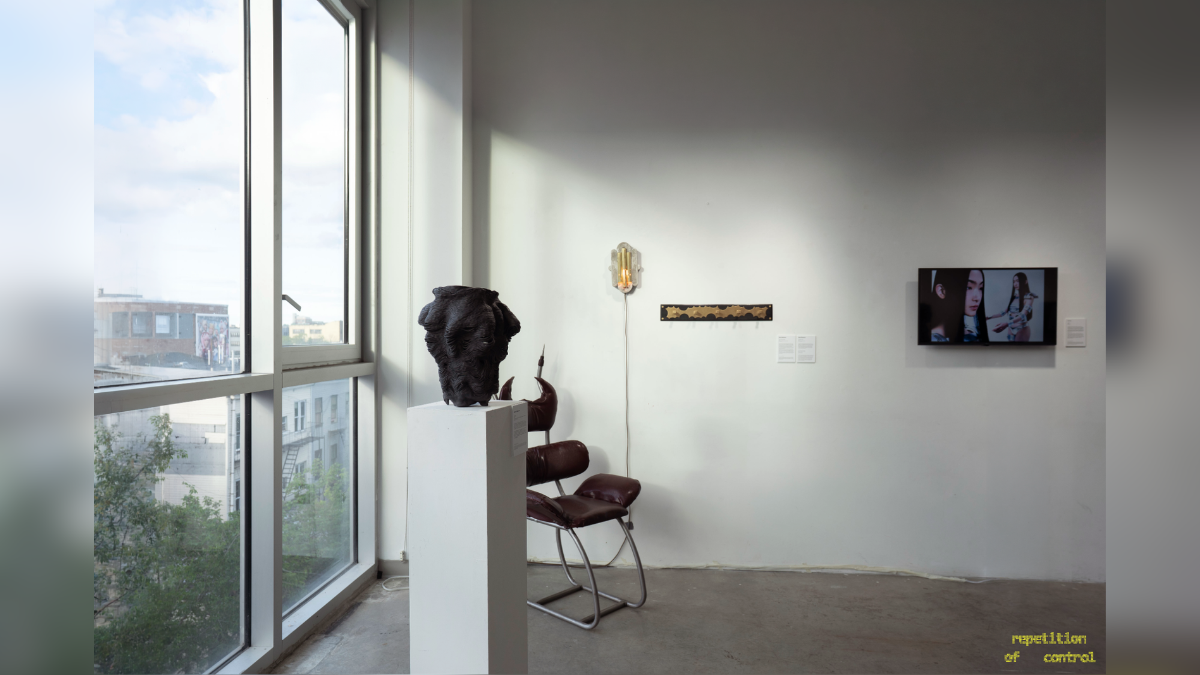
ALICE TEDESCO, LINEE, 2026.
Repetition is control, and this show quietly but surely questions and fights to resist the monotonous meaning behind repetition that used to signal this sense of boredom and describes the quality of lacking creativity. This show overthrows that ideation, reframing repetition into acts that are rebellious and ungraspable. Repetition as love, as beauty; as erasure of memories and resistance against technology; as survival in nature, and as obedience towards the existing system; repetition both preserves and destroys, allowing new creation but also trapping us humans in established rules. The show is perhaps resisting repetition and all that it brings, calling for viewers to slow down and think: How and why am I repeating whatever it is that I am about to do? (1979).