
 NEWS
NEWSInside Magnolia Pearl’s Handmade House of Fame, Appreciation, and Giving

Feb. 20 2026, Published 1:26 a.m. ET


Even before stylists built mood boards or brands negotiated contracts, clothing was discovered by necessity and kept by meaning. People wore what endured. In that older logic, recognition followed use, not arrangement. Magnolia Pearl, the Texas-founded fashion label created by Robin Brown, belongs to that lineage. Its relationship with celebrity culture did not begin with outreach or alignment. It began, as the brand itself did, with survival—then quietly traveled outward.
Brown’s first widely cited creation was a hand-sewn bag made of kite string and salvaged fabric, sold for exactly what she needed at the time. She learned to sew while navigating homelessness and scarcity, mending not to aestheticize poverty but to get through it. That origin matters, because Magnolia Pearl has never learned the language of spectacle. It has never needed to.
Visibility Without Machinery

Want OK! each day? Sign up here!
At a time when luxury brands often allocate more to placement than to production, Magnolia Pearl operates without paid endorsements or influencer contracts. Its garments appear on musicians, actors, and artists without prior arrangement. When stylists pulled Magnolia Pearl pieces for projects tied to Taylor Swift’s folklore and evermore era, the brand learned about it only after fans recognized the clothing. There was no campaign, no credit line waiting to be activated.
This pattern has repeated itself across music videos, films, and personal wardrobes. The names attached to the brand arrive by observation, not announcement. In fashion, where visibility is often purchased, this kind of discovery signals something else at work: affinity rather than alignment.
Why These Clothes Travel
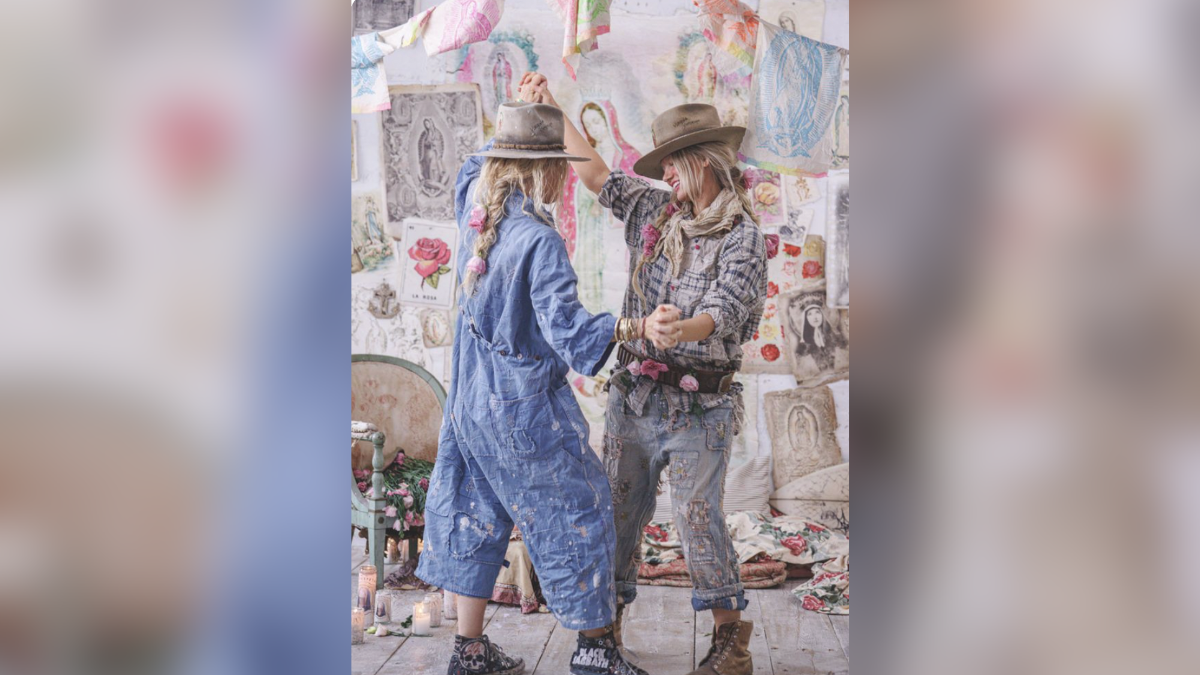
Magnolia Pearl’s garments are immediately legible. Patchwork is visible. Stitching is uneven. Frayed edges are not corrected. These clothes do not perform newness; they declare history. Each piece carries marks of labor and time, shaped by Brown’s refusal to hide repair.
That refusal reshapes how the garments behave after purchase. In resale markets and collector communities, Magnolia Pearl pieces routinely return years later as sought-after artifacts, changing hands well above their original value. This is not driven by hype cycles. It is driven by structure. The brand does not produce collections, does not follow seasonal calendars, and does not replenish on demand. Individual garments can take weeks to complete. Scarcity is built into the process, not layered on through marketing.
When Resale Becomes Intentional
In 2023, Magnolia Pearl formalized its secondary market through Magnolia Pearl Trade, the brand’s authenticated resale platform. The move brought structure to what collectors had long been doing informally, offering verification, centralized listings, and protection against counterfeits. Production samples and long-sold-out pieces reentered circulation, reinforcing the idea that the garment’s first owner was never meant to be the last.
Magnolia Pearl Trade also redirects value outward. A portion of resale proceeds is routed through the Magnolia Pearl Peace Warrior Foundation, which supports housing initiatives for Indigenous veterans, disaster relief, medical and veterinary care for people experiencing homelessness and their pets, and arts education programs. Since 2020, more than half a million dollars has been distributed through these efforts. Clothing circulates. Value circulates with it.
What Celebrity Recognition Reveals
Celebrity adoption, in this case, is not amplification but confirmation. Artists recognize something familiar in garments that refuse polish and perfection. Magnolia Pearl’s clothes do not signal status; they signal survival. They allow wearers to carry vulnerability without explanation.
The fashion industry often treats endorsement as proof of relevance. Magnolia Pearl suggests another measure. Its clothing is found, not placed. Its visibility emerges without orchestration. The garments endure long enough to be noticed.
A culture saturated with influence leaves little room for quiet reach. Magnolia Pearl offers a different lesson. When clothing is built from repair rather than replacement, recognition follows use. And sometimes, that is enough.