
 NEWS
NEWSInstant Withdrawal Casinos in Canada: What 'Instant' Actually Means

ILLUSTRATION OF A CASINO WITHDRAWAL REQUEST TRAVELLING FROM A CASHIER SCREEN THROUGH A PAYMENT NETWORK TO A CANADIAN PLAYER'S PHONE

Aug. 21 2026, Published 1:22 a.m. ET


"Instant withdrawal" is the most repeated promise in Canadian online gambling and the least precisely defined. It usually describes one specific stage of a three-stage process, and the two stages it leaves out are the ones that decide whether your money arrives in 40 seconds or 40 minutes.
The phrase is not dishonest. It is just narrower than most players read it. A site that approves your payout automatically has genuinely done its part instantly. What happens next belongs either to a payment network that has never heard of your account, or to a compliance framework that applies whether the cashier is fast or slow.
For Canadian players specifically, expectations are set by a domestic rail that feels immediate, which makes anything slower read as a fault rather than a design characteristic. Understanding where the time actually goes is the difference between choosing a genuinely fast site and choosing one with confident marketing.
Key Takeaways
- "Instant" almost always refers to internal approval, not money landing in your account.
- Settlement speed is set by the rail or blockchain you withdraw on, not by the casino's promise.
- Your first withdrawal is nearly always the slowest, and that is a compliance function rather than a stalling tactic.
- Canada's CAD 1,000 transfer-data threshold means verification triggers at a lower amount than in the United States.
- Confirmation policy explains why a $50 payout clears faster than a $50,000 payout through the same method.
The Three Stages of Any Casino Withdrawal
Every withdrawal moves through internal approval, transmission, and confirmation. "Instant" describes stage one only. Stages two and three are governed by the payment network's own timing and by how many confirmations the receiving side requires before treating funds as final.

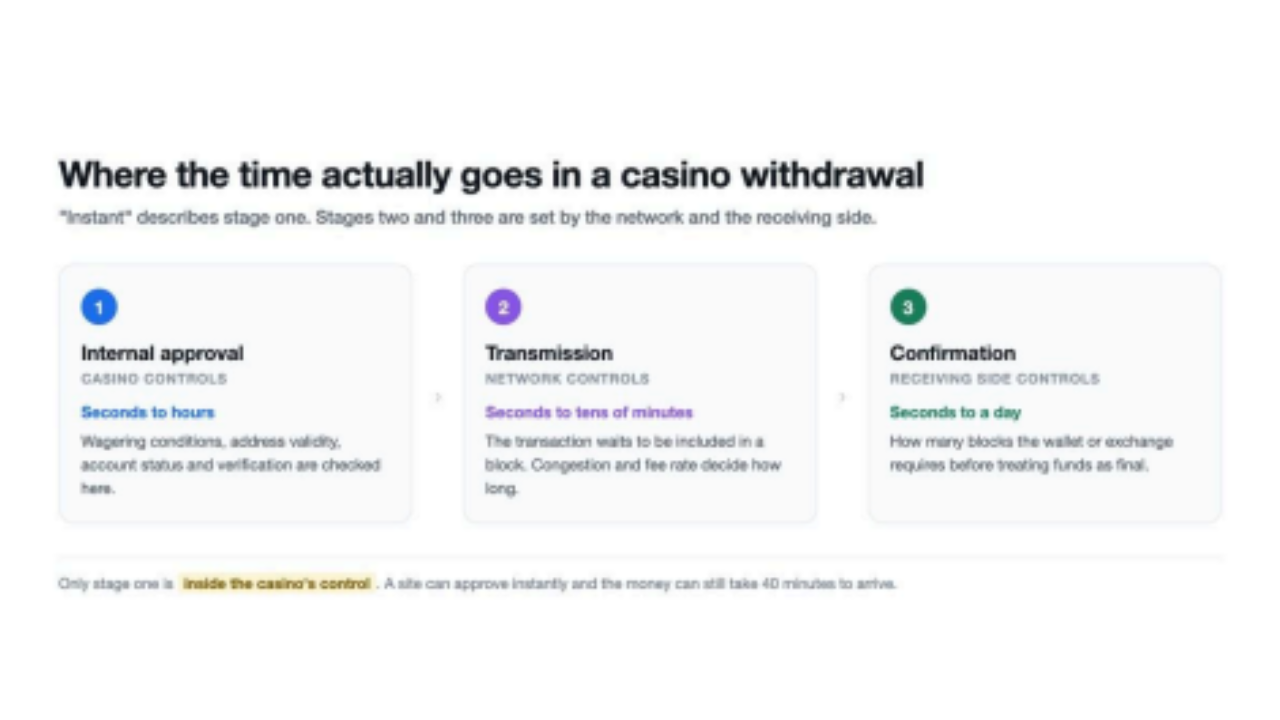
DIAGRAM SHOWING THE THREE STAGES OF A CASINO WITHDRAWAL, WITH ONLY INTERNAL APPROVAL CONTROLLED BY THE CASINO
Stage one is the only part a casino fully controls. It covers checking that wagering conditions are met, that the destination details are valid, that the account is not flagged, and that the balance is genuinely withdrawable. Sites that automate this call it instant, and for a returning verified account that description is accurate.
Stage two is transmission. For crypto, the transaction enters the network's pending pool and waits to be included in a block. For domestic bank rails, it enters a clearing process. Stage three is confirmation depth, meaning how much settlement assurance the receiving side wants before releasing the money to you.
| Stage | Who controls it | Typical duration | What can stall it |
|---|---|---|---|
| 1. Internal approval | The casino | Seconds to hours | Unmet wagering conditions, flagged account, pending verification |
| 2. Transmission | The network | Seconds to tens of minutes | Network congestion, fee rate, batch timing |
| 3. Confirmation | The receiving side | Seconds to a day | Confirmation policy scaled to amount |
Why Canadian Players Judge Payout Speed More Harshly
Canadian expectations are calibrated by Interac e-Transfer, the dominant domestic rail for moving money between Canadian bank accounts (Interac). Once a player is used to domestic transfers that feel effectively immediate, a payout measured in tens of minutes reads as something having gone wrong.
This is a perception gap rather than a performance gap. A Bitcoin withdrawal confirming in 40 minutes has not failed. It has behaved exactly as the network is designed to behave. But a player whose reference point is a domestic e-transfer will reasonably conclude otherwise, and that mismatch drives a large share of complaints about sites that are actually processing normally.
The second Canadian factor is regulatory. Ontario operates a distinct regulated market overseen by the Alcohol and Gaming Commission of Ontario alongside iGaming Ontario (AGCO), which sits separately from the international sites Canadian players in other provinces commonly use. Which category a site falls into affects what recourse you have, though it does not change the underlying settlement mechanics.
Why Your First Withdrawal Is the Slowest One
First withdrawals take longer because that is when identity and source-of-funds checks usually run. This is not discretionary. The Financial Action Task Force extended its Recommendation 16 "Travel Rule" to virtual assets in June 2019, and by 2025, 85 of 117 surveyed jurisdictions had passed Travel Rule legislation, up from 65 the year before (FATF Targeted Update, June 2025).
The rule requires identifying information about both sender and recipient to travel with qualifying transfers. FATF's recommended baseline is USD or EUR 1,000, but national implementations vary sharply, and Canada's is lower than several comparable markets.
| Jurisdiction | Transfer-data threshold |
|---|---|
| Canada | CAD 1,000 |
| United States | USD 3,000 |
| European Union | Zero, all transfers |
| Switzerland | CHF 1,000 |
| FATF global baseline | USD or EUR 1,000 |
Source: Chainalysis
Two consequences follow for Canadian players. Verification triggers at a lower amount here than for an American player making the same withdrawal. And a site that never asks anything is not being generous. It is either operating below a threshold or outside a framework, and neither is a reassuring explanation.
How Payout Method Changes the Timing
Method matters more than the casino's headline promise, because each rail has its own floor. On the crypto side, Bitcoin targets one block roughly every 10 minutes. Tron reaches initial confirmation in about three seconds and practical irreversibility after roughly 57 seconds, or 19 blocks (Eco, 2026). Solana settles in about one second.
Want OK! each day? Sign up here!
| Network | Typical settlement | What drives variance |
|---|---|---|
| Bitcoin | ~10 minutes per block, longer when congested | Pending pool depth and fee rate |
| Ethereum | Minutes | Gas market conditions |
| Tron (TRC-20) | ~3 seconds, ~57 seconds to practical finality | Energy or TRX burn model |
| Solana | ~1 second | Network load |
Bitcoin carries a second variable that the others largely avoid: congestion. Fees and wait times move with how full the pending pool is. In calm conditions a low fee rate confirms in the next block or two. During a heavy minting event the same transaction can sit for hours unless it pays a much higher rate, with recommended fees climbing above 200 sat/vB at the extremes (Spark, 2026). Live conditions are public at mempool.space.
Because the coin and the network are separate choices, the practical step is to read a cashier's supported coins and networks before depositing rather than after a payout starts to feel slow. A site that lists ten coins without naming networks has published a logo grid, not a payments page.
Why a Large Payout Takes Longer Than a Small One
Confirmation depth is set by the receiving service, not by the network. Bitcoin's own
documentation is explicit that merchants and exchanges "can and should set their own threshold as to how many blocks are required until funds are considered confirmed," with six or more blocks common among parties bearing double-spend risk (Bitcoin Wiki).
That same documentation stresses there is "nothing special about the default, often-cited figure of 6 blocks," and that genuinely large transfers warrant considerably more, up to 144 blocks or roughly a day for value comparable to the block reward. Confirmation policy is a risk judgement, and different services make it differently.
This is why two players withdrawing the same amount on the same afternoon report different experiences, and why "how long do withdrawals take" has no single honest answer. A small Bitcoin payout can be spendable after one block. A large one may wait an hour before the receiving side releases it. Sites that publish coin-level detail, such as a dedicated Bitcoin casino page, make that easier to anticipate than a single sitewide speed claim does.
It also explains a common misreading. When a large payout takes longer, the cause is often the receiving exchange's crediting policy rather than anything the casino did. The funds left on schedule.
How Withdrawal Limits Stretch a Large Payout
Speed and size interact in a way that headline claims never mention. Most sites apply daily, weekly or monthly withdrawal caps, and a win above the cap does not get refused. It gets split across multiple payouts on successive days. Each individual transfer may well be fast, while the full amount takes a week to reach you.
This is the single largest gap between "instant withdrawal" as advertised and instant withdrawal as experienced by someone who has actually won a meaningful sum. A site can honestly claim minutes-fast payouts and still take days to pay a large balance, because the constraint is the cap rather than the rail.
Caps also frequently vary by account tier, by payment method, and by whether the balance came from deposits or from bonus play. None of that is visible on a landing page. It sits in the terms, and it is worth reading before a large win rather than after one.
Two questions settle it before you deposit. What is the maximum you can withdraw per day and per month on the method you intend to use. And whether that cap rises with account status, which determines whether a large win is a one-week wait or a much longer one.
What Actually Delays a Withdrawal
Most delays trace to one of a short list of causes, and all but one are avoidable:
- Unmet wagering conditions. A bonus balance with outstanding requirements is not withdrawable, and the cashier will hold the request rather than reject it outright.
- Pending verification. First payouts commonly wait on documents. Submitting them before you request the withdrawal removes this entirely.
- Name or address mismatch. Payment details that do not match the account holder
- trigger manual review.
- Wrong network selected. Choosing a network your receiving wallet does not support can put funds beyond recovery rather than merely delaying them.
- Weekend and holiday timing. Rails involving banks inherit banking hours. Crypto networks do not.
- Network congestion. The one genuinely outside anyone's control, and the reason a fee-rate check is worth thirty seconds.
What to Have Ready Before Your First Withdrawal
Because verification is what makes a first payout slow, the whole delay is avoidable by front-loading it. Most sites let you complete verification before you request anything, and doing so converts a first withdrawal from the slowest into one that behaves like every later one. What is typically requested:
- Photo identification. A passport or driving licence, with all four corners visible and no glare across the data line.
- Proof of address. A utility bill or bank statement, usually issued within the last three months, showing the same name and address as the account.
- Proof of payment method. For cards, an image showing only the last four digits. For crypto, confirmation that the receiving wallet is yours.
- Source of funds. Requested for larger amounts, and satisfied by payslips, bank statements or similar records.
Three details cause most rejections, and all three are trivial to avoid. The name on the account must match the name on the documents exactly, including middle names where they appear. The address must match, which catches people who have moved since registering. And documents must be legible, since a rejected upload restarts the clock rather than pausing it.
How to Read a Casino's Stated Withdrawal Time
A withdrawal page worth trusting separates the parts the site controls from the parts it does not. It states an internal processing window, names the methods and networks it supports, and explains that settlement is a separate variable. Vague speed claims with no mention of method differences are the signal to be skeptical of.
Wild.io's published withdrawal-time guide is a reasonable model of the format: it lists supported coins including BTC, ETH, USDT, SOL, XRP and TRX, states that most payouts are processed within minutes, and attributes the remaining variance to network confirmation times rather than presenting one flat number.
Three checks before you deposit anywhere:
| What to check | Why it matters |
|---|---|
| Does the stated time mean approval or arrival? | These differ by minutes to hours, and marketing rarely distinguishes them. |
| Is your intended method named specifically? | A generic "crypto accepted" tells you nothing about your coin's settlement floor. |
| Does the page list what makes payouts slower? | A page with no failure conditions was written for marketing, not for players. |
Frequently Asked Questions
Are instant withdrawal casinos real?
Partly. Instant approval is real and common. Instant arrival is not, because the transaction still has to be transmitted and confirmed. On Solana that gap is about a second. On Bitcoin it is at least one block interval, usually around 10 minutes.
Why is my first withdrawal slower than the ones after it?
Because identity and source-of-funds checks usually run on the first payout. Once cleared, later withdrawals skip that step. In Canada, transfer-data obligations begin at CAD 1,000, which is lower than the United States threshold of USD 3,000.
Does paying a higher network fee make a casino pay out faster?
No. The fee affects transmission, meaning how quickly your transaction is included in a block. It has no effect on the casino's internal approval. If a payout is pending approval, no fee will move it.
Which withdrawal method is fastest for Canadian players?
Among crypto networks, Solana settles in roughly one second and Tron reaches practical finality in under a minute, both far quicker than Bitcoin's roughly 10-minute block target. Which is actually fastest for you depends on the methods a given site supports and on your own wallet or bank.
Is a casino that never asks for documents safer?
No, and usually the opposite. Absent verification means either the amounts fall below a threshold or the site operates outside a transfer-data framework. Neither indicates stronger player protection.
Can a casino refuse a withdrawal after approving it?
An approved and transmitted crypto transaction cannot be recalled, because settlement is final once confirmed. What can happen is a request being held before transmission, which is why the approval stage is where disputes concentrate.
Why do withdrawal times differ between two sites using the same coin? Because the difference is in stage one and stage three, not the network. One site may auto-approve while another reviews manually, and receiving services set their own confirmation thresholds.
Responsible Gambling Resources
Fast payouts should not be a reason to play more than you intended. Support is available in Canada and internationally:
- ConnexOntario for free, confidential support in Ontario
- CAMH, the Centre for Addiction and Mental Health
- Responsible Gambling Council
- Gamblers Anonymous
- Gambling Therapy
Sources
- Chainalysis, Travel Rule glossary entry
- FATF, Targeted Update, June 2025
- Bitcoin Wiki, Confirmation
- Eco, USDT TRC-20 Confirmation Time
- Spark, Bitcoin Mempool Economics
- Alcohol and Gaming Commission of Ontario
- Interac e-Transfer