
 NEWS
NEWSUnderstanding How Dogs Think: Belynda Moore’s 30-Year Mission to Transform Owner Mindset Through Dog Psychology

BELYNDA MOORE

Feb. 24 2026, Published 1:59 a.m. ET


Around the world, dogs and humans share a unique bond. According to research, in the US, over half of households have at least one dog. However, only around 8% of dog owners have ever enrolled their pet in obedience training programs. Ultimate K9, founded by Belynda Moore, aims to offer personalized dog training with an emphasis on understanding each dog’s unique psychology.

Moore has spent over 30 years in the dog training industry, but her journey began with her first dog, Mandy. Her parents bought Mandy to protect Moore and keep her company during her childhood newspaper route, while she was saving money to buy a horse. “Mandy was a smart dog; she picked things up very quickly,” Moore says. “At the time, I didn’t know what I was doing, but I recognized that Mandy was picking up skills and learning. That was the beginning for me.”
Throughout her teenage years, Moore worked with specialized trainers, which helped her gain a deeper understanding of dog psychology and overall learning processes. She said, “Understanding dogs is integral for training because every dog behaves and thinks differently, which is why we need to approach each of them as individuals.”
Ultimate K9 offers services including private lessons, group classes, boarding and training, online classes, seminars, and workshops. As part of her private lessons, Moore offers customized instructions to dog owners to deepen their understanding of dog psychology. Group lessons help build reliability, confidence, and improve the dog’s obedience and social skills.
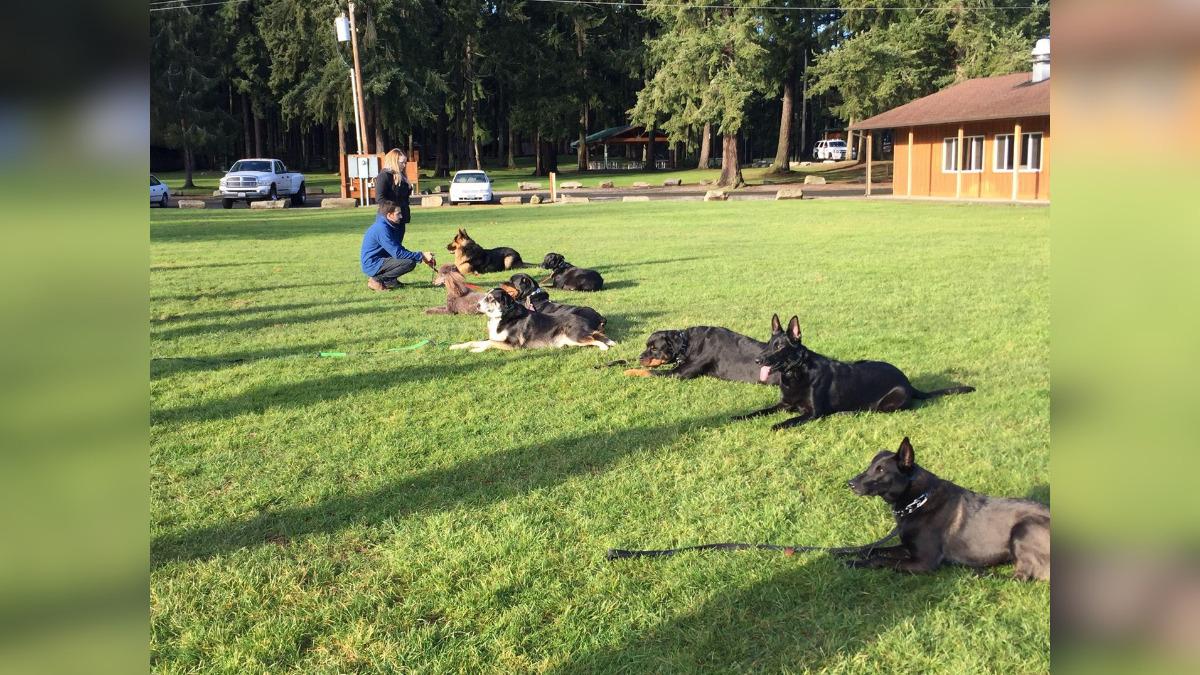
ULTIMATE K9
Want OK! each day? Sign up here!
Moore also focuses on continuing educational opportunities for owners, offering different membership options, providing a variety of services such as dog walks and video learning subscriptions as part of the plans.
According to recent research, almost 86% of dogs have moderate to severe separation anxiety. Moore believes the problem is rooted in training and is a primary concern dog owners face. Moore says, “Separation anxiety and reactivity are the most common issues my clients are facing, and a lot of it comes from lack of structure, guidance, and limitations. There needs to be some set rules, even in day-to-day life.”
As an experienced dog trainer, Moore believes there is a difference between dog psychology and human psychology. According to her, dogs think differently from humans and do not have the same cognitive reasoning, which is important when analyzing and interpreting information. Moore says, “Dogs learn through discovery, and live in the moment, whereas owners often hold onto the past. Dog owners need to realize that the way dogs react is different from the way humans do. Understanding that difference can be crucial in raising a well-behaved dog.”
Dog owners tend to rate their pets more highly than their closest human companion, excluding their closest kin, romantic partner, best friend, and children. But Moore believes there are important factors, beyond training, to think of before bringing a new dog into the home. She says, “Breed, genetics, and temperament are crucial. The training follows from there. Just because a dog can be trained to do something does not mean it is right for them, or what they were bred to do.”
Moore aims to reach a wider audience through her online training program, which she plans on launching in March 2026. “The idea is to introduce the fundamentals of dog psychology to more owners, because for training to be effective long term, it is vital to understand how your dog thinks, what they’re trying to communicate, and how your own behaviors are impacting your dog’s response,” Moore says. “In the end, I’m not the one who will be living with the dog, you are.”