
 Politics
Supreme Court Lets Donald Trump Keep Building $400 Million White House Ballroom — for Now

The Supreme Court allowed Donald Trump’s $400 million White House ballroom project to continue.

Sept. 5 2026, Published 6:14 a.m. ET


President Donald Trump’s $400 million White House ballroom can keep going, at least for now.
In an apparent 5–4 decision on August 31, the Supreme Court allowed construction to continue while lawsuits over the project move forward, replacing a temporary order that had briefly threatened to halt the work. The ruling is a win for Trump’s sweeping White House makeover, but it did not decide whether he has legal authority to build the ballroom.
Instead, the unsigned order found that the National Trust for Historic Preservation, which sued to stop the project, likely did not have standing to challenge it.
Roberts Breaks With Conservatives


Chief Justice John Roberts disagreed with the decision and called the project ‘likely unlawful.’
Chief Justice John Roberts, who was appointed by former President George W. Bush, publicly disagreed with the decision and joined the court’s three liberal justices in dissent.
“Today’s decision is no victory for the separation of powers,” Roberts wrote.
He said the project is “likely unlawful” because Congress has not approved it, citing federal law that bars construction on public grounds in Washington, D.C., “without express authority of Congress.”
“The White House is not just any building,” Roberts wrote, warning that the court had allowed “the Executive’s likely infringement of the Legislature’s power of the purse” to continue.
A Fast-Moving Makeover

The proposed White House renovation expanded into a massive ballroom and military complex.
The ballroom project has grown far beyond its original public pitch. What began as a proposed event-space renovation estimated at $200 million has become a 90,000-square-foot ballroom and military complex, with underground facilities the administration says are needed for national security.
The White House has said crews are working 20 hours a day. Court documents say the framework could be finished in November, much of the facade by April and the full project by August 2028.
The administration argued that halting construction would cause irreparable harm. Solicitor General D. John Sauer also said the project is being built with materials used in nuclear power plants and would be extremely difficult to dismantle.
The Trust’s lawyers, meanwhile, argued the White House was trying to “outrun the courts” by accelerating development.
Want OK! each day? Sign up here!
Donald Trump Celebrates the Ruling

Donald Trump celebrated the ruling while preservation advocates vowed to continue their legal fight.
Trump celebrated the decision on social media, saying the Supreme Court had ruled in favor of the “Ballroom/Military Complex being built without any further contingency, doubt, or threat.”
“When completed in the Summer of 2028, the magnificent Ballroom and Military Complex will be something that the entire Country is very proud of,” he wrote.
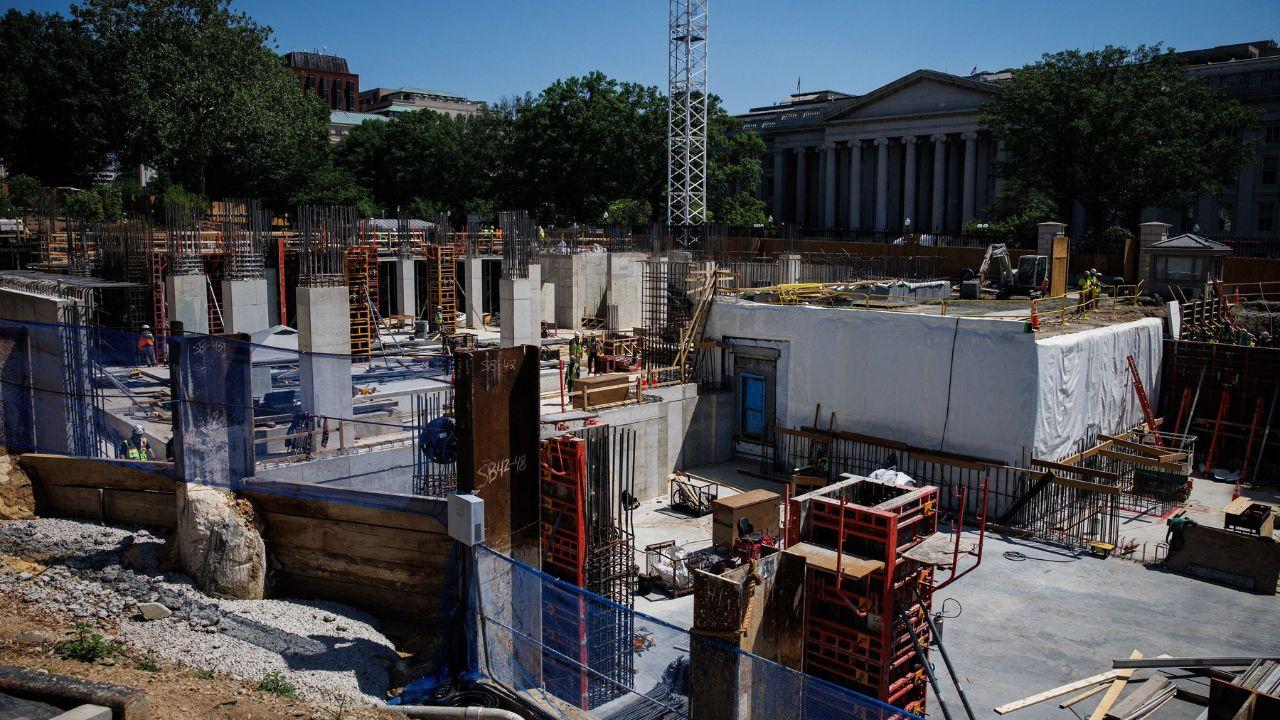
The court’s decision allowed construction to proceed without resolving the project’s legality.
Brent Leggs, president and CEO of the National Trust for Historic Preservation, said in a statement that the group was disappointed but noted the ruling was not a final decision on the merits.
“Our fundamental argument” remains, he said, that each president is “a temporary steward of the People’s House” and cannot “demolish and redesign it without the approval of Congress.”